

· Giuseppe Sirigu · 25 min read
Route Optimization for Beverage Distributors: The Complete Operations Guide
A practical guide to route optimization for mid-size beverage distributors running 10–100 trucks. Covers sequencing, delivery windows, three-tier compliance, and vendor evaluation.
Most mid-size beverage distributors are running routes that look reasonable on a map and feel wrong by 2 PM. Drivers are calling in late. Chain grocery accounts are triggering chargebacks. The summer beer surge is two weeks out and the routes aren’t ready. Overtime is eating margins that were already thin.
The problem is rarely a shortage of trucks or drivers. It’s the routes themselves.
Route optimization in beverage distribution is not a GPS problem. It is a sequencing problem, a constraint problem, and a data problem - all at once. A 140-mile route with stops in the wrong order will consistently underperform a 180-mile route sequenced correctly. A route that handled a 2,200-case Tuesday in March will buckle under a 3,800-case Tuesday before the Fourth of July. And a route optimized for distance will miss a hard grocery receiving window every time it’s forced to choose.
This guide is a complete operational reference for dispatch managers, route supervisors, and operations directors running 10 to 100 trucks in beer, wine, spirits, and non-alcoholic beverage distribution. It covers every dimension of the route optimization problem - sequencing science, delivery window management, how beverage distribution works operationally, three-tier compliance, technology evaluation, and measurement - with enough specificity to be useful regardless of what software you currently use or whether you’re considering a change.
In This Guide
- What Route Optimization Actually Means
- The True Cost of Suboptimal Routes
- Route Sequencing: Why Stop Order Beats Distance
- Delivery Window Management
- How Beverage Distribution Works
- Why Beverage Distribution Breaks General-Purpose Route Tools
- Evaluating Route Optimization Technology
- The Eight Metrics That Actually Matter
- Getting Started: Route Audit and 90-Day Pilot
- Where to Start
What Route Optimization Actually Means in Beverage Distribution
The term “route optimization” gets applied to everything from basic map routing to enterprise logistics platforms with machine learning backends. Before going further, it’s worth being precise about what the problem actually is.
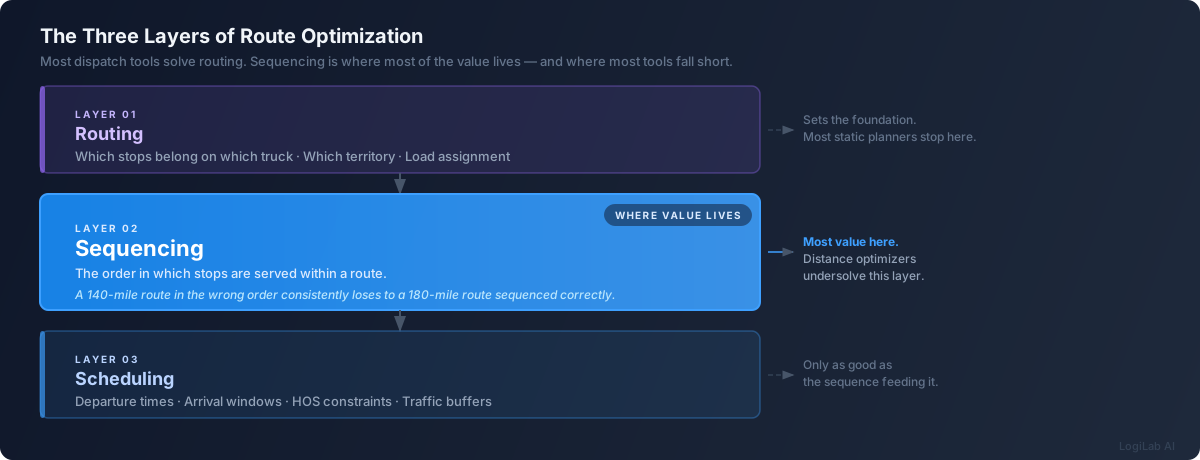
Route optimization in beverage distribution has three distinct layers:
1. Routing - determining which stops belong on which truck and which territory on any given day. This is the territory design and load assignment problem.
2. Sequencing - determining the order in which stops are served within a route. This is where most of the value is, and where most static planning tools fall short.
3. Scheduling - determining when a truck departs and arrives at each stop, accounting for delivery windows, service times, traffic, and HOS constraints.
Most dispatch managers think about routing. The best ones obsess over sequencing. The difference between the two is the difference between a route that looks good in the morning and one that actually holds together at stop 18 of 25.
Beverage distribution is harder than parcel delivery for three structural reasons:
- Stops are not equal. A chain grocery account with a hard 6:30 AM receiving window is fundamentally different from a bar that takes delivery whenever the morning bartender shows up. Treating them identically in route planning creates failures that compound across the route.
- Stop time is highly variable. A driver at a convenience store dropping 2 cases of energy drinks takes 6 minutes. The same driver at a grocery account with a 4-pallet beer delivery, manual count, and signature requirement takes 45 minutes. If your route plan uses average stop times, your schedule is wrong from the first stop.
- The load has to match the route sequence. The truck must be loaded in reverse delivery order - last stop loaded first, first stop loaded last. Keg accounts add a second layer: empties need to come back, which means pickup sequencing has to be planned alongside delivery sequencing. If any of this changes after loading, you either reload or accept an inefficient unload at every affected stop.
The True Cost of Suboptimal Routes
Before looking at solutions, it’s worth quantifying the problem. The costs of bad routing are distributed across the P&L in ways that make them easy to undercount.
Direct costs:
- Overtime: When routes run long due to poor sequencing, every hour of driver overtime costs $25–$45 depending on market and agreement - consistent with BLS median wages for heavy truck drivers of $24.28/hour, at a 1.5× overtime rate. A fleet of 40 trucks where 30% of routes generate one overtime hour per day accumulates $110,000–$200,000 in excess overtime annually at those rates.
- Redeliveries: A missed delivery window at a grocery account doesn’t disappear - it becomes a redelivery. Industry analysis puts the all-in cost of a failed delivery - including driver time, fuel, and administrative overhead - between $85 and $180 per incident depending on drop size and distance. At 8% missed-window rates - an estimate consistent with distributor operations running static route plans - a 40-truck fleet executing 25 stops per truck per day misses roughly 80 stops per day. Even if only 20% require full redelivery, that’s 16 redeliveries daily.
- Fuel: Suboptimal routing adds mileage. Using the variable fuel cost component of $0.17–$0.19 per mile reported in ATRI’s annual trucking cost analysis for local/regional operations, every 5% increase in mileage on a 40-truck, 200-miles-per-day fleet adds roughly $25,000–$28,000 per year.
Indirect costs:
- Chargebacks: Grocery chains assess chargebacks for missed receiving windows. Retailer compliance programs vary widely, but chargeback amounts in the $100–$500 range per incident are commonly reported by distributors serving major grocery chains, with repeat violations risking loss of preferred vendor status.
- Account attrition: Chronic delivery reliability failures eventually cost accounts. The lifetime value of a single mid-size grocery account is measured in years of revenue. Route failures are one of the most preventable sources of account attrition.
- Dispatcher time: When routes fail in the field, dispatchers spend 2–4 hours per incident on rescheduling, driver communication, and customer calls. That time has an opportunity cost - it’s not spent on planning or improvement.
The calculation most distributors haven’t done:
Take your fleet size. Multiply by your average stops per truck per day. Apply an 8% missed-window rate (industry median for distributors without optimization tools). Calculate the redelivery cost, chargeback exposure, and overtime associated with that failure rate. For most mid-size distributors, the number is uncomfortably large and the opportunity is proportionally significant.
Route Sequencing: Why Stop Order Beats Distance
The most counterintuitive insight in beverage distribution route optimization is that total distance is a weak predictor of route performance. Stop sequence - the order in which accounts are served - matters more.
The Traveling Salesman Problem, Made Practical
The classic theoretical problem in combinatorial optimization is the Traveling Salesman Problem (TSP): given N cities, find the shortest route that visits each city exactly once and returns to the start. For 10 stops, there are 181,440 possible sequences. For 25 stops, the number of distinct sequences exceeds 3 × 10²³ - more than the estimated number of stars in the observable universe, and completely impossible to evaluate exhaustively.
Dispatch managers cannot evaluate all sequences manually. This is why route planning software exists. But basic route planning software typically solves for distance or time minimization - it treats the problem as a pure TSP variant. Beverage distribution isn’t a TSP. It’s a Vehicle Routing Problem with Time Windows (VRPTW), which adds hard constraints - delivery windows, keg pickup sequencing, hour restrictions - that a pure distance solver cannot handle correctly.
How Delivery Windows Turn Distance Into Irrelevance
A delivery window at a grocery DC (6:00–8:00 AM) is a hard constraint. If your truck arrives at 8:05 AM, you miss the window. The route planner that optimized for distance sent you to three closer stops first, burning the window. A longer route that respected the 6 AM constraint would have outperformed on every meaningful metric: no missed window, no chargeback, no redelivery.
This is the core reason why dispatch managers who plan routes by eye or by static optimization consistently struggle: they’re optimizing for the wrong variable.
Worked Example: 22-Stop Grocery Route
Consider a realistic 22-stop route for a regional beer distributor covering the eastern suburbs of Charlotte - Concord, Kannapolis, and the surrounding communities:
- 2 chain grocery DC stops with hard receiving windows (6:00–7:30 AM)
- 6 grocery and supermarket direct stops with soft windows (8:00 AM–12:00 PM)
- 7 convenience store stops with owner-preferred windows (6:30–10:00 AM)
- 4 bar and restaurant on-premise accounts with 10:00 AM–12:00 PM windows
- 3 package liquor store stops with flexible windows (9:00 AM–12:00 PM)
A distance-optimized route might cluster stops geographically, running a c-store loop before the first grocery DC stop. Result: the driver hits the DC at 7:25 AM - barely inside the window - then spends the rest of the morning fighting the wrong sequence as grocery accounts and c-stores pull the route in opposite directions.
A window-constrained sequence starts with the two DC stops (departure 5:15 AM, first DC at 6:00 AM), then sweeps through the c-stores in the same geographic zone while windows are open, works through grocery and liquor accounts mid-morning, and finishes with on-premise bar and restaurant deliveries at 11:00 AM when those accounts are ready to receive. Total mileage is 11% higher. Total route time is 50 minutes shorter. Zero missed windows.
The difference isn’t software sophistication - it’s recognizing that delivery windows are the binding constraint and sequencing around them, not around distance.
Want to see what this looks like on your actual routes? We're accepting three beverage distributors into a founding cohort. Join the waitlist and we'll reach out.
Join the waitlist →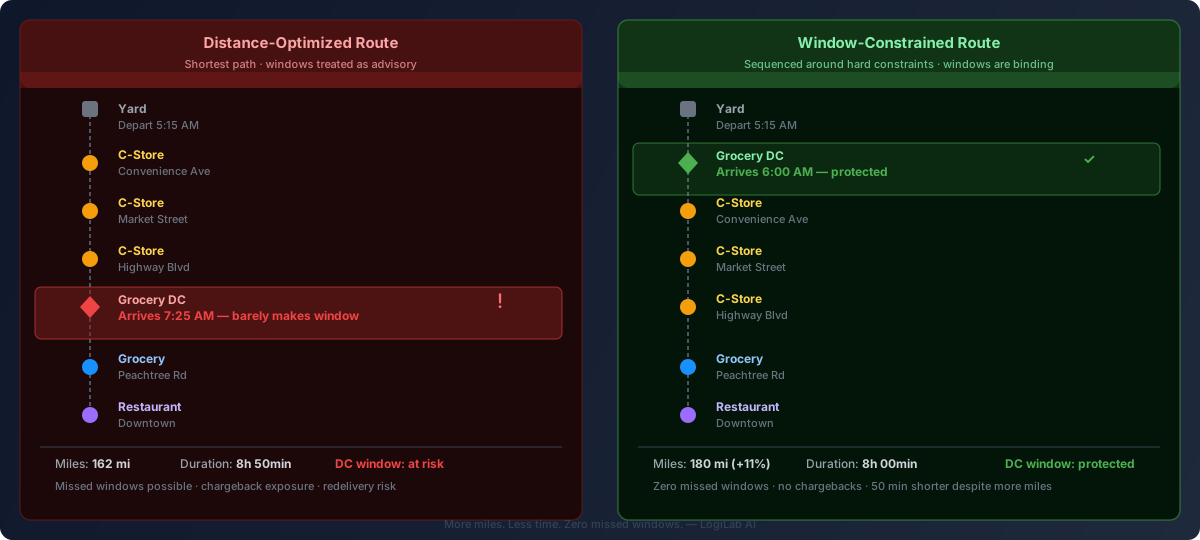
Delivery Window Management
Delivery windows in beverage distribution are not uniformly distributed. They cluster at the worst possible times for fleet utilization.
The 6 AM–8 AM Crunch
Grocery distribution centers typically receive product in early morning windows. If you serve even a handful of grocery DC accounts, a significant portion of your fleet needs to depart the yard by 5:00–5:30 AM to meet those windows. This creates a departure bottleneck at the yard, compresses driver prep time, and means any loading error discovered on departure has zero recovery time.
The solution is not to accept this as fixed. It’s to plan backward from the window constraints and build every other decision (loading sequence, driver assignment, pre-trip inspection scheduling) around the hard constraint at the front of the route.
The Domino Effect
Delivery windows interact. A 15-minute delay at stop 3 cascades through the remaining route because travel time buffers between stops are calculated against planned arrival times, not actual ones. By stop 10, a 15-minute delay at stop 3 has frequently grown to a 35–45 minute delay - because the driver is now hitting each subsequent stop at a slightly worse point in their service time, traffic has shifted, and small inefficiencies compound.
This is why re-sequencing capability matters more than initial optimization. A route that is optimally sequenced at 5:30 AM departure may be suboptimally sequenced by 9 AM if conditions have shifted. A system that can propose a revised sequence in the field - skipping stop 14 to protect a hard window at stop 15, for example - recovers value that a static system loses permanently.
Buffer Time Without Killing Utilization
The standard dispatcher response to missed windows is to add time buffers: “leave 20 minutes between each stop.” This works until it doesn’t. Blanket buffers reduce utilization - the metric most operations directors are measured on - without targeting the actual failure points.
A better approach is asymmetric buffering: apply buffers precisely where the historical data shows schedule variance, not uniformly across the route. A grocery DC stop at 6:00 AM needs a 20-minute buffer because the cost of a miss is a chargeback plus a redelivery. A restaurant stop at 10:30 AM with a flexible window and a reliable owner needs zero buffer. Treating these identically wastes capacity on the flexible stop and underprotects the hard one.
How Beverage Distribution Works
Beverage distributors deliver directly to retail accounts — grocery, c-store, on-premise, liquor — from their own trucks, bypassing the retailer’s distribution center. This direct-to-store model means every stop is a live service event with its own timing, load requirements, and relationship dynamics. The operational realities differ from warehouse-to-DC distribution in ways that affect every aspect of route planning.
Fixed Routes vs. Dynamic Routes: When Each Makes Sense
Fixed routes - the same driver serves the same accounts on the same days each week - provide consistency that benefits both drivers and account relationships. Drivers know their accounts, understand store layouts, have established receiving relationships, and can identify and address issues proactively. Grocery and c-store accounts often prefer fixed routes because they know when to expect delivery.
Fixed routes have a ceiling. They cannot adapt to volume changes, account additions, or seasonal shifts without manual intervention. A fixed route that worked for a 20-stop Tuesday in February becomes a 28-stop Tuesday in July when summer beverage volume peaks. Running fixed routes through volume surges either breaks the route or requires emergency additions that are expensive and operationally disruptive.
Dynamic routes recalculate based on actual order volumes, account requirements, and fleet availability. They optimize for current conditions rather than historical patterns. For distributors with significant volume variability - seasonal, promotional, or event-driven - dynamic routing captures meaningful efficiency that fixed routing cannot.
The pragmatic answer for most mid-size distributors: maintain fixed route territories (driver-account relationships) while allowing dynamic sequencing within those territories based on current day orders and conditions. This preserves the relationship benefits of fixed routing while capturing the sequencing efficiency of dynamic optimization.
Load Sequencing: The Constraint That Starts the Night Before
The most important sequencing decision in beverage distribution is made not during route planning but during route loading. A truck must be loaded in reverse delivery order - the first stop on the route goes on last, the last stop goes on first. This means that loading errors or sequencing changes after loading are not free corrections. They require either reloading (costly) or accepting an inefficient unload order that adds minutes at every affected stop.
Operationally, this creates a hard dependency: route sequencing must be finalized before loading begins. For a fleet that loads at night for morning departures, this means sequencing decisions must be made the night before, incorporating current order volumes, driver assignments, and any known schedule changes.
Dispatchers who rely on manual sequencing or static software frequently finalize sequences at loading time and then encounter a change - a driver callout, a weather event, an account that adds a last-minute order - that invalidates the sequence after loading has started. The result is either a reload or a compromised route.
Driver-Account Relationships and Route Design
In beverage distribution, the driver is not just a delivery agent — they are often the primary relationship between the distributor and the retail account. Experienced drivers know which receiving manager is difficult, which loading dock has a broken lift, which accounts tend to have back-order issues, and which managers approve credits on the spot versus requiring a dispatch call.
Pure optimization algorithms that ignore driver-account relationship history will reassign drivers to accounts where they have no established relationship, creating friction that costs time (longer service times, more approval delays) and damages account satisfaction. The best route planning approaches treat driver-account affinity as a soft constraint: the optimization respects established relationships unless there’s a compelling efficiency reason to override them, and even then, only with sufficient lead time for a warm handoff.
Seasonal Flexing
Every beverage distributor experiences seasonality - and the swings are more extreme than in most distribution categories. The question is whether you flex routes proactively or reactively.
Reactive flexing - adding trucks when the volume already exceeds capacity - means two to four weeks of chaos before operations stabilize. It also means paying surge rates for temporary capacity and drivers who don’t know the territory.
Proactive flexing uses three years of delivery data to identify the week-by-week volume ramp, pre-positions temporary driver capacity, adjusts territory splits before volume peaks, and builds contingency sequences for the 40% volume scenario before it arrives. The planning work happens in February. The execution is controlled.
Why Beverage Distribution Breaks General-Purpose Route Tools
Beer, wine, spirits, and soft drink distribution share the core sequencing and window challenges of all distribution - and add a layer of regulatory and logistical complexity that general-purpose route planning tools are not built to handle. Three-tier compliance, keg logistics, delivery hour restrictions, and seasonal volume swings create routing constraints that require domain-specific enforcement at the account level. A route optimization tool that doesn’t know the difference between an on-premise bar and a grocery DC will eventually generate a compliance violation or a missed window.
Three-Tier Compliance as a Hard Routing Constraint
The three-tier system - producers, distributors, retailers, legally separated - is the foundational compliance structure for alcohol distribution. Your distributor license specifies exactly which accounts you’re authorized to serve in which jurisdictions. Delivering to an unlicensed account, crossing into a jurisdiction where you’re not licensed, or delivering outside permitted hours isn’t just an operational error - it’s a license violation.
For route planning, this creates account-level constraints that general-purpose route optimization tools typically don’t enforce. A route that crosses a county or state line may require a separate license. An account classified as on-premise (bar, restaurant) has different rules than an off-premise account (grocery, liquor store) in many states. The route plan needs to know the difference.
Delivery Hour Restrictions
Most states restrict when alcohol can be delivered, independent of when it can be sold. Common restrictions prohibit delivery before 7:00 AM or after 9:00–11:00 PM, but the specific hours vary by state and sometimes by municipality. A route optimized for distance that schedules an on-premise delivery at 6:45 AM in a restricted jurisdiction generates a compliance violation regardless of whether the account is willing to receive.
Route planning for beverage distributors must enforce these hour restrictions at the account level, not treat them as advisory guidelines. A route planner that doesn’t have jurisdiction-level delivery hour data built in will eventually create a compliance incident.
Keg and Returnable Logistics
Keg delivery is a pickup-and-delivery problem layered on top of a standard delivery route. Every keg delivered is a keg owned by the distributor. Empties need to come back. The route plan must accommodate keg pickups at accounts that have empties ready - often different accounts than those receiving fresh product - without creating backtracking that destroys route efficiency.
This is a genuinely hard optimization problem that most generic route planning tools treat as an afterthought. The result is that distributors either plan keg pickup routes separately (inefficient), run dedicated pickup trucks (costly), or leave it to driver discretion (unpredictable). Integrating keg pickup as a dual constraint in route optimization - where the route is sequenced to minimize backtracking while completing both deliveries and pickups - is one of the clearest examples of beverage-specific optimization value.
Keg delivery also carries a compliance dimension. Kegs are property of the distributor, and deposit tracking is a state-level requirement in many markets. The route plan should treat keg pickup as a scheduled event with its own stop-time estimate and deposit documentation requirement - not an afterthought left to driver discretion, which creates accounting and compliance gaps downstream.
Seasonal Volume Spikes
Summer beer season, Super Bowl week, the holiday spirits surge - beverage distributors experience volume events that are predictable in timing and magnitude but still regularly cause operational failures. A distributor who ships 2,200 cases on a typical Tuesday in March may ship 3,800 cases on the Tuesday before the Fourth of July.
Routes designed for 2,200 cases do not hold at 3,800. Territory splits that work at base volume create adjacent routes that are both over-capacity at peak. The seasonal planning problem is not “how do we handle today’s surge” - it’s “how do we redesign our territory and route structure for June through August, then transition back to base configuration in September.”
FSMA for Non-Alcoholic Beverage Lines
Distributors carrying non-alcoholic beverages - soft drinks, energy drinks, water, juice - alongside or instead of alcohol fall under the FDA’s Sanitary Transportation of Human and Animal Food rule (FSMA, effective April 2017). The four core requirements are vehicle sanitation, temperature control documentation, driver training records, and 12-month retention of transport records.
For route design, the practical implication is sequencing temperature-sensitive non-alcoholic lines to minimize door-open time. Routes that interleave refrigerated and ambient stops without reason extend cumulative cold chain exposure and create documentation gaps if temperature excursions occur.
Evaluating Route Optimization Technology
The technology market for route optimization includes solutions ranging from basic mapping tools with route planning features to enterprise logistics platforms with multi-year implementation timelines. For mid-size beverage distributors, the relevant evaluation space is narrower - and the common failure modes are specific.
Static vs. Adaptive Optimization
Static route optimization calculates an optimal or near-optimal solution for a defined set of inputs and returns a fixed route plan. Input the stops, windows, vehicle capacities, and constraints; receive a route sequence. The plan is as good as it can be given those inputs at that moment.
Static optimization has real value. For distributors currently planning routes manually or by rule-of-thumb, published implementation results from route optimization deployments - including case studies from Descartes and Upper - consistently show mileage reductions of 8–15% and overtime reductions of 10–20% in the first year. The ceiling is that static optimization doesn’t learn. Each planning cycle starts from scratch.
Adaptive optimization systems - often described as AI-powered or machine learning-based - update their models based on observed outcomes. When a driver consistently takes 42 minutes at a particular grocery account rather than the planned 25 minutes, an adaptive system updates its stop-time model for that account. When summer volume patterns show a 35% spike every year in weeks 26–28, an adaptive system builds that pattern into its baseline planning assumptions.
The practical difference between static and adaptive optimization becomes significant over time. At week 1, both systems work from the same inputs. At week 52, the adaptive system has ingested a year of delivery data and is producing plans that reflect the actual operating reality of your fleet and accounts, not the theoretical model you started with.
What “AI-Powered” Actually Means (and When It’s Just Marketing)
Every route planning vendor currently uses the phrase “AI-powered.” It means almost nothing without specificity. The questions that reveal the substance:
- Is the optimization heuristic-based, mathematical programming-based, or learning-based? Heuristic-based tools use rules of thumb (nearest neighbor, sweep algorithms) that are fast but not optimal. Mathematical programming (linear programming, integer programming) finds near-optimal solutions for well-defined problems. Learning-based systems (reinforcement learning, neural approaches) improve over time from outcome data.
- What does the system learn from? A system that “learns” by updating stop-time estimates based on historical actuals is doing something real. A system that “learns” by letting you manually adjust parameters is not learning - it’s giving you a configuration interface.
- How long until the learning is useful? Any learning system has a cold-start period where it’s working from defaults or sparse data. A vendor who can’t answer “what does performance look like at week 4, week 12, and week 26” either hasn’t measured it or doesn’t want you to know.
The Integration Question
Route optimization does not exist in isolation. For beverage distributors, the route planning system interacts with:
- Route accounting software (eoStar, Encompass, VIP, KARMA) - where orders are entered, invoiced, and reconciled
- Proof-of-delivery systems - where delivery confirmations and signatures are captured
- ERP or warehouse management systems - where inventory availability is tracked
- HOS compliance systems - where driver hours are monitored
A route optimization tool that doesn’t integrate with your route accounting software is a tool that requires manual data entry on both ends. For a 40-truck fleet, that’s 40 routes manually re-entered each morning. The integration question should be asked early in any vendor evaluation: what systems do you integrate with natively, and what does the integration actually exchange?
The Eight Metrics That Actually Matter
Most distribution operations track miles driven, fuel cost, and on-time delivery rate. These are useful but incomplete. A complete route optimization measurement framework includes:
1. On-Time Delivery Rate by Window Type Separate your hard-window accounts (grocery DCs) from soft-window accounts (restaurants) from no-window accounts (c-stores). A 94% overall on-time rate that hides a 78% on-time rate for grocery DC stops is a dangerous average.
2. Stops Per Route Actual vs. Planned If drivers are consistently completing fewer stops than planned, the route plan is wrong - either stop times are underestimated or sequences are creating time losses you’re not accounting for.
3. Overtime Rate by Route Which routes generate overtime and how frequently? Chronic overtime on specific routes signals a sequencing, stop-time estimation, or territory design problem that a route audit can identify.
4. Redelivery Rate What percentage of stops require a redelivery? Track this by account and by route. Redelivery clustering on specific routes reveals window-management failures that are fixable.
5. Route Adherence Are drivers following the planned sequence? Significant divergence from planned sequence either means the planned sequence is wrong (drivers are improvising a better route) or drivers are taking shortcuts that create window failures later. Both are diagnostic.
6. Miles per Stop Total route miles divided by number of stops, by route and by territory. Increasing miles per stop over time signals territory expansion without route rebalancing.
7. Fuel Cost per Delivery More sensitive than total fuel cost. Declining delivery volume on a fixed route increases fuel cost per delivery even if total fuel is flat.
8. Driver Retention by Route Assignment Which routes have higher driver turnover? Routes that consistently generate overtime, unpredictable end times, or excessive physical demands drive turnover at a rate that the route planning data can predict before the driver quits.
Getting Started: A Route Audit Before Any Software Purchase
The most common mistake mid-size distributors make in route optimization is buying software before understanding their current state. Software implemented without a baseline measurement produces results you can’t validate. You don’t know if performance improved, held flat, or declined on metrics you weren’t tracking.
The 30-Day Route Audit
Before evaluating any technology, spend 30 days capturing the following data:
- Actual departure times vs. planned departure times for every route
- Actual stop arrival times vs. planned for the first 5 stops on each route (spot-check)
- Actual stop completion times vs. planned (to identify accounts where service time estimates are wrong)
- Window miss incidents with account, time, and downstream impact
- Overtime hours by route and by driver
- Redelivery incidents with root cause (missed window, not home, refused, etc.)
This 30-day data set is your baseline. It tells you where your current route plans are failing and why. It also gives you the inputs you need to validate any optimization tool you evaluate - if a vendor’s demo produces results dramatically better than your baseline, ask them to show you results on your actual route data, not a curated sample.
The 90-Day Pilot Framework
If you proceed to a technology evaluation, a structured 90-day pilot is the minimum credible test:
- Days 1–30: Data integration and baseline calibration. The system ingests your historical data, calibrates stop-time models, and produces initial optimized sequences. Compare planned sequences to your current routes - not to implement them yet, but to identify the biggest divergences and understand why.
- Days 31–60: Parallel operation on a subset of routes (5–10 trucks). Run optimized sequences alongside your standard routes for the same territory. Measure the difference in overtime, window compliance, and mileage.
- Days 61–90: Full implementation on pilot routes. Measure against baseline. Identify the edge cases the system handles poorly (it will have some) and assess the vendor’s responsiveness to feedback.
A vendor unwilling to structure a pilot this way - insisting on a full fleet deployment without a controlled comparison - is a vendor who doesn’t want you to measure performance objectively.
Where to Start
If you recognized your operation anywhere in this guide, the next move is data - not software.
Pull 30 days of actuals: departure times, window misses, overtime hours, redelivery incidents. If you don’t have this data in one place, the act of collecting it will already tell you something.
What you find determines where to focus:
Overtime clusters on specific routes. That’s a sequencing or territory design problem. Re-read Route Sequencing and How Beverage Distribution Works.
Window misses concentrated at grocery accounts. That’s an asymmetric buffering failure - you’re under-protecting hard windows and wasting capacity on flexible ones. Re-read Delivery Window Management.
Redeliveries spread across multiple route types. That’s usually a stop-time estimation problem. Your planned windows don’t reflect actual service times. Pull planned vs. actual stop times for two weeks and compare.
Performance falls apart at seasonal peaks. You’re building territory splits reactively. If you’re redesigning routes in June, you’re already behind. Re-read Seasonal Flexing.
The 30-day audit data also gives you the only credible baseline for evaluating any technology vendor. A tool that can’t demonstrably improve on your measured numbers isn’t worth implementing.
Start there.
Sources
Bureau of Labor Statistics - Occupational Employment and Wage Statistics: Heavy and Tractor-Trailer Truck Drivers (SOC 53-3032), May 2023. Median hourly wage $24.28; overtime rate basis for cost estimates used in this post. bls.gov
American Transportation Research Institute (ATRI) - An Analysis of the Operational Costs of Trucking, 2023 Update. Variable and marginal cost components for local/regional truck operations used for per-mile fuel cost estimates. atri-online.org
Applegate, Bixby, Chvátal & Cook - The Traveling Salesman Problem: A Computational Study, Princeton University Press, 2006. Winner of the 2007 INFORMS Lanchester Prize. Foundational reference on TSP combinatorial complexity - the number of distinct tours for n cities is (n–1)!/2: 181,440 for 10 stops, ~3.1 × 10²³ for 25 stops. Companion resource at math.uwaterloo.ca/tsp
Desrochers, Desrosiers & Solomon - “A New Optimization Algorithm for the Vehicle Routing Problem with Time Windows,” Operations Research, Vol. 40, No. 2, pp. 342–354, 1992. DOI: 10.1287/opre.40.2.342. Preprint freely available via GÉRAD: gerad.ca. Foundational paper establishing VRPTW as the correct problem formulation for constrained delivery routing - the basis for the argument that beverage distribution is not a TSP.
OneRail - “How Does Bad Delivery Service Affect a Business? The Cost Is More Than You Think.” Analysis of failed delivery costs including driver time, fuel, and administrative overhead. onerail.com
Descartes Systems Group - Route optimization implementation case studies and benchmarks for beverage distributors, including mileage and overtime reduction ranges cited in the Technology section. descartes.com
National Beer Wholesalers Association (NBWA) - Industry data, operational benchmarks, and regulatory guidance for beer distributors. nbwa.org
Wine & Spirits Wholesalers of America (WSWA) - Industry benchmarks and compliance guidance for wine and spirits distributors. wswa.org
FDA - FSMA Final Rule: Sanitary Transportation of Human and Animal Food - Applicable to non-alcoholic beverage carriers. Effective for most carriers April 6, 2017. fda.gov
Giuseppe Sirigu
Founder of LogiLab AI. PhD in Aerospace Engineering, Politecnico di Torino. Leader in AI and data science, building optimization systems for high-stakes operational environments.
Founder's Cohort
See how this applies to your operation.
We're accepting three beverage distributors into a founding cohort. Join the waitlist and we'll reach out to schedule a discovery call.